Outcomemaxxing
In December 2024, we published a short blog about outcome-based pricing. Eighteen months later, it’s still one of our most read posts and the subject of intense debate in our industry.
Our logic was simple: traditional enterprise software is about productivity tools for teams. Given AI can do the work, customers should pay for outcomes, not usage — and two things quickly became clear:
- First, there’s a real desire for transparency. Enterprise pricing is opaque by design, so any vendor willing to be paid by results stands out.
- Second, AI is as disruptive to business models as it is technology. It’s why existing software companies have so many questions. These are part practical — does this actually work? — and part existential: what does it mean if it does?
Since December 2024, the S&P 500 is up ~30%. WCLD — the WisdomTree Cloud Computing ETF, the closest thing to a SaaS index — is down ~15%.
The Saaspocalypse, as it has been dubbed, is the market internalizing that the future is not productivity tools for teams but AI agents that deliver outcomes.
Lessons learned from outcome-based pricing so far
First, outcome-based pricing rewires your company.
It focuses everyone — sales, agent development, product, support, marketing — on the job to be done: delivering the promised result for customers. If you don't deliver, attrition and margin take a hit in a way that simply does not happen when you charge for consumption or seats. Every company cares about customer success, but with outcome-based pricing it’s baked into the P&L.
Second, outcome-based pricing is more complex than seat-based or consumption pricing — operationally, contractually, accounting-wise. People telling you it's simple are selling something.
It only works where the software is highly autonomous and highly attributable. If the work isn't autonomous, you're really just selling a tool, and tools price by usage or by seat. If the outcome can't be cleanly attributed to the software, you’ll get into an endless debate.
How enterprise technology is priced
Charging for Intelligence by Madhavan Ramanujam sets out a useful 2x2 thinking that matches our experience better than anything else we’ve seen. There are two axes: the software’s agency, and how cleanly the outcome can be attributed to it.

The bottom-left is classic seat-based SaaS — the dominant model of the last 15 years. You buy a license per user, the software helps them do work, attribution to outcomes is fuzzy.
The top-left is API and infrastructure pricing — OpenAI, AWS. The software is doing real autonomous work, but you can't cleanly tie any particular outcome to any particular API call. Usage-based pricing is the natural fit.
The bottom-right is an interesting hybrid — seats with metered consumption layered on top. Cursor is the cleanest current example. The product is still largely managed by people, but enough of the work is being done by AI that consumption informs the pricing model.
The top-right is where Sierra sits — high agency, high attribution. Pricing by outcome is nuanced, so we’re not dogmatic about it and do consumption-style work where it fits the shape of the problem. But our driving force as a company is the top-right quadrant.
The AI gold rush
Let’s step back and think about what's actually happening in the market right now.
Enterprise software is changing from productivity tools for teams, to AI that can get things done. Can traditional enterprise software companies thrive in that world? Yes, but not by doing exactly what they do today.
We are, by any reasonable definition, in the middle of a gold rush. There's an enormous amount of capital and attention flowing into AI, and a lot of people building businesses around it. And like every gold rush before it, the gold — an undifferentiated commodity that trades at the prevailing spot rate — won’t be the enduring part.
In retrospect, the enduring part of the 1849 gold rush was the businesses built to serve the rush. Levi Strauss & Co. founded in San Francisco in 1853 to sell dry goods to miners, and Wells Fargo founded in 1852 to move gold and mail between mining camps. While what they sell today is different from what their founders sold, both were able to create value for customers as the world changed around them.
Incentives drive outcomes
When you charge on seats, your incentive is to expand the number of seats. When you charge on consumption, your incentive is to drive more usage. Both of those tie you to a product surface — a particular way of solving a problem. The minute the underlying technology shifts, your incentive points in the wrong direction.
That is what’s happening to seat-based SaaS right now. The product surface (a person logging in to do work) is being eroded by AI faster than the business model can adapt.
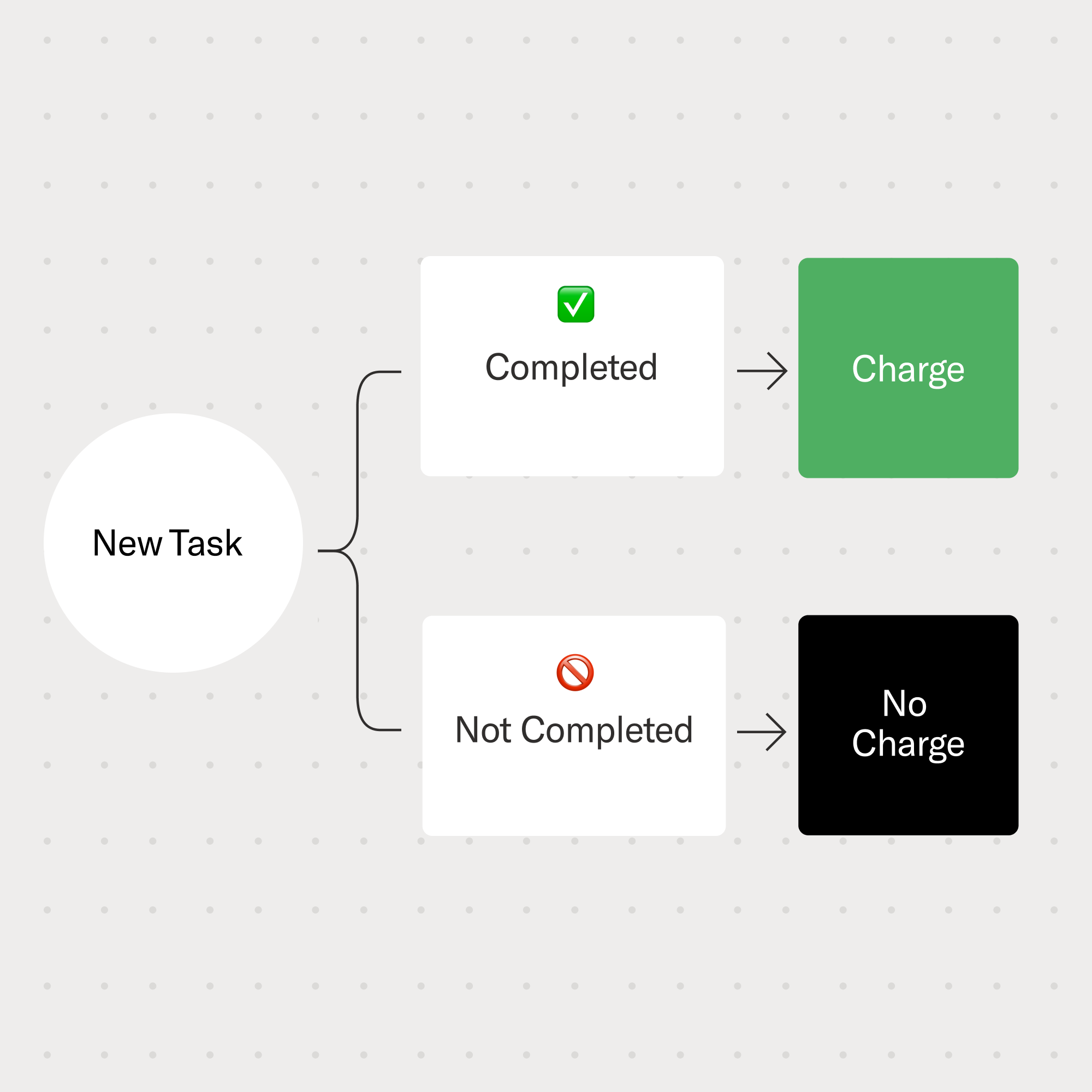
When you charge on outcomes, your incentive is to get the job done: complete the mortgage application, retain the subscriber, process the insurance claim, increase the basket size. How you do that (the model or architecture behind it, what the agent looks like, whether there's a person in the loop) can change.
The cost of raw intelligence is going to fall. That's the clearest trend in technology right now. Software priced on top of that compute will compress with it. What doesn't compress is outcomes: a customer who did not churn, a home sold, an insurance claim processed has the same value, irrespective of what the model costs. It’s why customers aren’t beholden to our gross margin — we’re beholden to their future success.
The enduring value of outcomes
We don't claim to have this all figured out. Every quarter we run into some new issue or edge case. It’s why we’re flexible. But the direction of travel is clear. The companies that endure will be the ones selling outcomes, not access.